
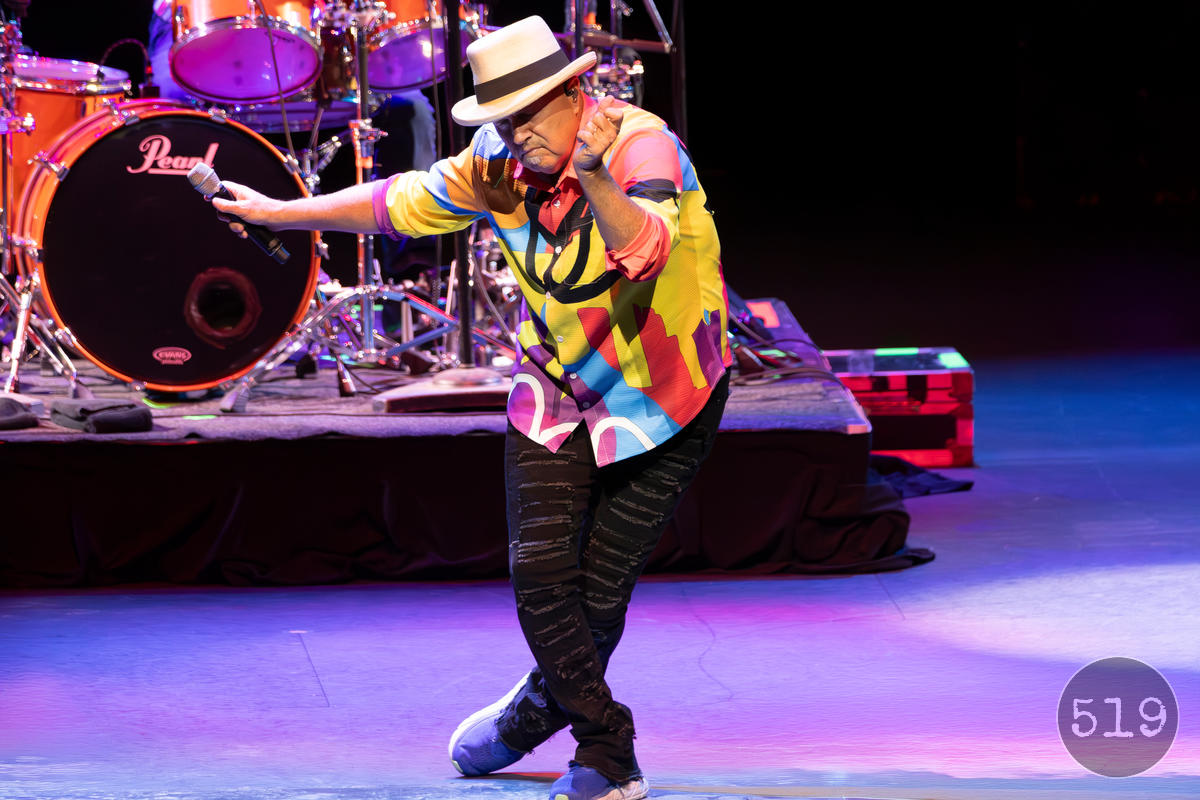
 Sawyer Brown played the OLG Stage at Fallsview Casino in Niagara Falls on March 27, delivered a 22-song set that ran close to two hours, and left a sold-out room wondering exactly how a band pushing 45 years together still moves like it has something to prove.
The answer, apparently, is frontman Mark Miller. At 67, the Ohio-born singer is somewhere between a carnival barker and a revival preacher — working the lip of the stage in ripped black jeans and a wildly colourful graphic shirt, white fedora cocked at a defiant angle, mic in one hand and attitude in the other. The man does not stand still. He crouches, he spins, he jabs the microphone at the crowd like he’s conducting a verdict. The visual alone is worth the ticket.
The current tour, The Boys and Me Live 2026, launched in January and is threading its way through both the U.S. and Canada in celebration of the band’s 40-year legacy. The Niagara stop dropped mid-run and had the feel of a machine that’s fully broken in — no rough edges, no guesswork, just a band that knows exactly what it’s doing and enjoys every second of it. That ease comes partly from the weight of the moment: the tour follows the release of Desperado Troubadours, a Blake Shelton-produced album, as well as a memoir from Miller and a documentary film, Get Me to the Stage on Time. It’s a lot of retrospection for one touring cycle. On stage, though, none of it reads as nostalgia. It reads as confidence.
The set opened with “The Boys and Me” and never really exhaled. Early cuts like “Drive Me Wild,” “This Time” and “Cafe on the Corner” established the rhythm fast — tight, polished country-pop that hits clean and loud, the kind of music that skips past your critical faculties and lands directly in your feet. Live performance has always been the band’s real currency. You hear it in how drummer Joe Smyth locks in behind even the mid-tempo stuff, how Gregg “Hobie” Hubbard’s keys sit right in the mix without ever overreaching. This is a group that has simply played together too long to be anything but locked.
Guitarist Shayne Hill is the other thing worth talking about. Fans who follow the band consistently single him out and on this night it was easy to see why — his playing on “All These Years” had real snap to it, the kind of Telecaster-forward attack that doesn’t sound like much until you try to replicate it and can’t. He also took lead vocal duties on “This Night Won’t Last Forever,” the Bill LaBounty cover, and “Swingin’,” the John Anderson song, and handled both with confidence. The vocal rotation keeps the show from flattening out. Smart arrangement.
The Kenny Rogers tribute — a reading of Don Schlitz’s “The Gambler” — was the night’s most emotionally pointed moment and Miller played it straight. No camp, no wink. The crowd sang every word, unprompted, and there was something genuinely moving about a room full of casino-goers reciting that lyric with real precision. The dead-air before Miller started the next song said more than any formal tribute speech would have. Some things you just let breathe.
Hubbard’s lead on the Joe Walsh cover “Life’s Been Good” was an inspired left turn. It’s a loose, silly song, and it gave the band permission to get goofy mid-set in a way that paid off — the crowd was laughing before the first chorus landed. But Hubbard had a side bet running. Before the show, he’d wagered Miller $100 that he’d earn a standing ovation. So mid-song, he ripped open his dress shirt to reveal a Superman tee underneath, egged the room on with the kind of showmanship that makes casino crowds forget they had somewhere else to be, and collected. The ovation came. Whether Miller actually paid is between them.
Recent concert-goers from other stops on the tour have noted the band’s consistent energy and Miller’s voice remaining as strong as it was decades ago. That tracks. There were no cracks, no half-committed high notes, no evidence of a singer pacing himself for the long haul. If he’s conserving anything, he hides it expertly. The screaming kid on the corner of the stage at the end of “Step That Step” and “Betty’s Bein’ Bad” was the same guy from every other show — meaning all of them.
The only honest critique is that the set list has calcified a bit. The Desperado Troubadours album gets zero direct representation in the set — no “Nashville Cat,” none of the title track — and for a band that just put out new music produced by Blake Shelton, that’s a miss. The record was built specifically to honour the band’s storytelling instincts and country traditionalism, which is exactly the register they were operating in all night. It would have fit. The crowd would have followed. Instead, the night leaned entirely on the catalogue, which works — but it does leave the newer material stranded.
“Thank God for You” and “Fishin’ in the Dark” closed the main sequence with the kind of loose, jubilant energy that earns the room’s goodwill for the night. Miller and Hill trading lead on “Fishin’ in the Dark” — both of them playing it for laughs, the crowd fully in on the bit — was exactly what a room full of people who drove to Niagara Falls on a Thursday needed. And “Should’ve Been a Cowboy,” the Toby Keith cover, landed with the reverence the song carries in the current climate. Hill sang it, and he sang it right.
What makes Smyth’s performance all the more striking is that he’s been battling muscular issues that would sideline most players his age. He sat behind that Pearl kit and played with more precision than a healthier drummer half his years — every fill landed, every transition was clean, nothing telegraphed the physical cost. The proof was “The Race Is On.” That punchy, locomotive beat is still one of the finest things in country music, full stop. Hearing it live — with Smyth locking the groove in real time, the low-end thwack of the kick sitting perfectly under the band — is worth the price of admission on its own. The crowd knew it too. The room shifted the moment that pattern kicked in. Some songs earn their reputation every single night they’re played. That one does.
The closer, “Some Girls Do,” was foregone the moment the first chord hit. The song still works the way it worked in 1991 — that opening hook, that chorus, that slightly reckless tempo — and the room stood for it. All of them. There are fans who have seen this band eight, nine times, who keep showing up because the show delivers something consistent and real. You understand it by the time “Some Girls Do” ends and Miller takes his bow in that absurd shirt and that fedora, grinning like he invented the whole racket.
He kind of did. And 45 years on, he’s still running it.
Photos by Dan Savoie


