
There is no announcement in music that generates more heat, more argument, and more passionate wrongness than the annual Rock & Roll Hall of Fame inductee list. Every April, a class gets announced, and within hours the discourse has fractured along familiar fault lines: the traditionalists screaming that hip-hop and R&B have no business in a rock hall, the progressives pointing out that the hall’s own founding mandate was never as narrow as those people want it to be, and somewhere in the middle, a few thousand Iron Maiden fans quietly noting that their band has sold over 100 million records and somehow needed five decades to get through the door. The 2026 class, revealed April 14 on ABC and Disney+ during a Rock & Roll Hall of Fame-themed episode of American Idol, is going to be one of the loudest arguments yet. And honestly? The hall earned it.
The 2026 Performer inductees are Phil Collins, Billy Idol, Iron Maiden, Joy Division/New Order, Oasis, Sade, Luther Vandross and Wu-Tang Clan. The Early Influence Award goes to Celia Cruz, Fela Kuti, Gram Parsons, Queen Latifah and MC Lyte. The Musical Excellence Award recognizes producer Rick Rubin, songwriter Linda Creed, legendary producer-arranger Arif Mardin and Rolling Stones producer Jimmy Miller. And the Ahmet Ertegun Award — given to non-performing industry figures who shaped the culture of rock and roll — goes to Ed Sullivan. The induction ceremony tapes Nov. 14 at the Peacock Theater in Los Angeles and airs in December on ABC and Disney+.
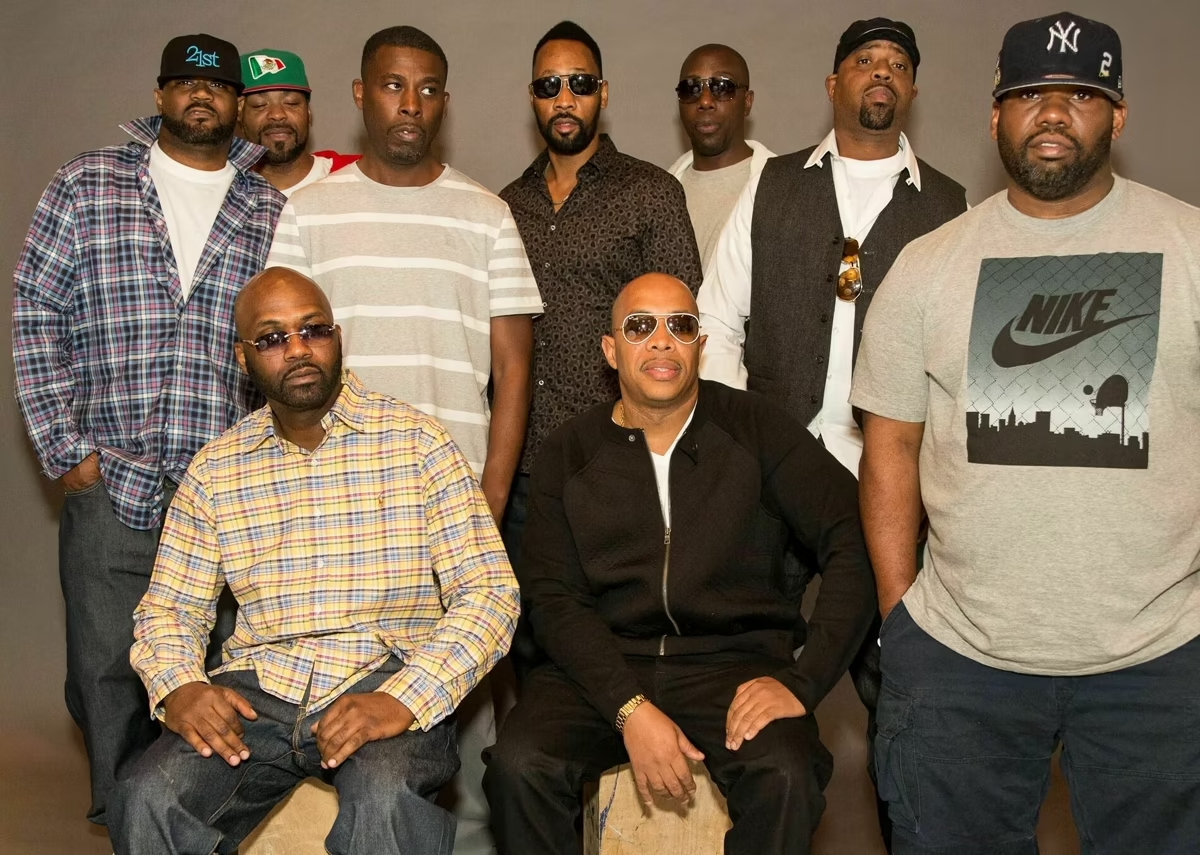
Let’s start where the argument starts: yes, Wu-Tang Clan is in the Rock & Roll Hall of Fame. Staten Island’s most fearsome collective, the architects of one of the most distinctive and influential sounds in the history of American music, the group that gave the world Enter the Wu-Tang (36 Chambers) in 1993 and changed what hip-hop could be structurally, lyrically and sonically — they’re in. This will bother people. Those people are wrong, but they are entitled to be wrong loudly. The hall’s own founding documents describe an institution born from the collision of rhythm and blues, country and gospel, and the mandate has always been about cultural impact, not guitar amplifiers. Wu-Tang Clan has cultural impact in quantities that most rock bands can only dream of. The argument that they don’t belong is an argument about what you wish the hall was, not what it actually is.
The same conversation, with slightly less volume, surrounds Sade and Luther Vandross. Both are towering figures. Both belong in any serious conversation about the most important artists of the last 40 years. Neither one is, by any conventional measure, a rock act. Sade’s cool, architectural soul and Vandross’s gospel-rooted R&B sit at a considerable distance from “School’s Out” or “Whole Lotta Love.” But the hall has been inducting artists from across the spectrum for decades now — Whitney Houston, Tupac Shakur, Janet Jackson — and the question of whether the institution should be a pure rock museum or a broader celebration of popular music’s most significant voices was settled years ago. The answer the hall chose is broad. These inductions are consistent with that answer.
Now the cases that require no defending at all. Iron Maiden. Finally. The British heavy metal institution has spent five decades building one of the most ferociously loyal fanbases in the history of recorded music, selling over 100 million albums without a conventional hit single to their name, and doing it without radio, without compromise and without ever once sounding like anyone other than themselves. Steve Harris’s galloping bass lines, Bruce Dickinson’s operatic roar, the twin-guitar assault of Adrian Smith and Dave Murray — these are sounds that defined an entire genre and shaped generations of players. They were nominated before and didn’t make it. The hall’s credibility among rock’s heavy end has taken real damage from that delay. Getting them in now is the right move, even if it’s late.
Phil Collins is another one that shouldn’t require much argument but will get it anyway — because Collins occupies that strange cultural position where massive commercial success has somehow been used against him. The man was the drummer in Genesis at the height of their prog-rock ambitions, fronted the band through one of the most unlikely commercial pivots in rock history, and then launched a solo career that produced some of the most recognisable pop and rock of the 1980s. “In the Air Tonight.” “Sussudio.” “Another Day in Paradise.” Whether you love those songs or find them overplayed to the point of parody, their place in the soundtrack of a generation is undeniable. Collins has been a first-time nominee this year. That he wasn’t in sooner is its own small argument.
Billy Idol’s induction is similarly overdue. The former Generation X frontman helped give punk its commercial edge without gutting its attitude, then built a solo career that made him one of the defining faces of early MTV — that snarl, that raised fist, that impossibly bleached hair framed by a leather jacket. “White Wedding,” “Rebel Yell,” “Eyes Without a Face” are not deep cuts. They are foundational documents of a specific and important era. Idol had been nominated previously without making the cut. He’s in now. It’s about time.
Oasis is the class’s most significant induction for anyone who came of age in the ’90s. The Gallagher brothers’ combustible chemistry — Liam’s sneer, Noel’s melodic genius, the tension between them that was always one bad night from implosion and finally did implode — produced some of the most anthemic rock of the Britpop era and beyond. (What’s the Story) Morning Glory? is one of the best-selling albums in British history. “Wonderwall,” “Champagne Supernova,” “Don’t Look Back in Anger” have outlasted the band itself, which only recently reunited. Their induction was inevitable. What took so long is a separate question.
Joy Division/New Order is the class’s most intellectually interesting induction — a dual recognition that acknowledges the full arc of what Ian Curtis and then Bernard Sumner, Peter Hook, Stephen Morris and Gillian Gilbert built across two distinct chapters. Joy Division’s bleak, post-punk intensity gave rock a new emotional vocabulary in the late ’70s. New Order took the wreckage of that and built something entirely different, pioneering the marriage of rock and electronic dance music that became the template for everything from shoegaze to Britpop. “Love Will Tear Us Apart.” “Blue Monday.” Both sides of this story matter. Both are in.
The Early Influence and Musical Excellence categories deserve more attention than they typically get. Gram Parsons in the Early Influence category is a genuinely significant acknowledgment — the man essentially invented country rock, mentored Emmylou Harris and cast a shadow over American roots music that reaches all the way to today. Celia Cruz and Fela Kuti reflect the hall’s increasingly global and cross-genre understanding of what shaped popular music. And Rick Rubin receiving the Musical Excellence Award is one of those moments where even the most cynical observer has to nod — the man produced Beastie Boys, Johnny Cash’s American Recordings, Red Hot Chili Peppers’ Blood Sugar Sex Magik, Metallica’s Death Magnetic and about a hundred other records that collectively reshaped what rock and popular music could sound like. If that’s not musical excellence, the phrase has no meaning.
But the induction that deserves the longest pause is the Ahmet Ertegun Award going to Ed Sullivan. The television host who gave The Beatles their American debut on Feb. 9, 1964 — the night that 73 million people watched and rock and roll in the United States was never the same again — has been a ghost at the hall’s feast for years. Sullivan didn’t play an instrument. He didn’t write songs. What he did was hand rock and roll its biggest possible stage at the exact moment it needed one, and he did it repeatedly, for Elvis, for the Doors, for the Rolling Stones, for a generation of artists who needed a national platform before there was any other way to reach one. The hall recognising that influence with its industry award is one of the smartest things they’ve done in years.
The Rock & Roll Hall of Fame has been inducting artists since 1986, when Chuck Berry, Little Richard, Elvis Presley, Buddy Holly, Ray Charles and Jerry Lee Lewis were part of the inaugural class — a group so foundational it reads less like a ceremony and more like a creation myth. Since then the hall has brought in everyone from Led Zeppelin and the Rolling Stones to Tupac Shakur, Stevie Wonder, Madonna and the Beastie Boys. The institution has inducted over 300 artists. It has also left out, for years at a stretch, names that seemed obvious — Kate Bush only got in in 2023, Cyndi Lauper in 2024. The pattern of oversights and corrections is part of the hall’s identity at this point.
The critique that some of these 2026 inductees aren’t rock and roll is real and worth taking seriously, even if the conclusion it points toward is wrong. There is a version of the Rock & Roll Hall of Fame that only houses artists who play guitars loudly and trace a clean line back to Chuck Berry and Little Richard. That would be a more coherent institution. It would also be a less honest one. Rock and roll didn’t stay in its lane in 1955 and it hasn’t stayed in its lane since. The artists who pushed the form into new territory — who took the rhythm and blues foundation and bent it into something the architects couldn’t have predicted — are exactly the kind of people the hall should be recognising. Wu-Tang Clan changed music. Sade changed music. The hall that refuses to reckon with that is a hall that has decided its own mythology is more important than the actual history.
The 2026 Induction Ceremony tapes in Los Angeles on Nov. 14 and airs in December on ABC and Disney+. In 2027, the ceremony returns to Cleveland, where the physical museum sits on the shore of Lake Erie and houses five floors of the most comprehensive rock and roll archive in the world. If you haven’t been, go. The argument about who belongs there is more fun when you’ve stood in front of Kurt Cobain’s cardigan and thought about it seriously.
Iron Maiden are in the Rock & Roll Hall of Fame. Phil Collins is in. Billy Idol is in. Ed Sullivan finally gets the recognition that anyone who understands what that Feb. 9, 1964 broadcast meant has been waiting for. Wu-Tang Clan is in, and the argument about whether they belong will last approximately until the ceremony, at which point someone will perform something extraordinary and the argument will briefly not matter. That’s how this always goes. That’s why we keep watching.